🔬 Scientific method & experimental design
SC.912.N.1.1 · Fig. 1.1 — The Scientific Method Flowchart (Bing Images)
Fig. 1.1 — The Scientific Method Flowchart
Change ONE independent variable. Use a control group with multiple trials and a large sample size. No penalty for guessing on the EOC — never leave blank.
| Term | Definition |
|---|---|
| Independent variable | Deliberately changed — "I change it" — only ONE per experiment |
| Dependent variable | Measured in response — "depends on the change" |
| Control group | No treatment applied; baseline for comparison |
| Theory | Well-supported explanation backed by extensive evidence |
| Law | Describes a consistent pattern — explains what, not why |
💧 Chemistry of water
SC.912.L.18.12 · Source: Study.com — Water Molecule Polarity & Hydrogen Bonding
Water molecule polarity & hydrogen bonding — adapted from Study.com
| Property | Cause | Real-world example |
|---|---|---|
| Cohesion | H₂O attracts H₂O (H-bonds) | Water droplets, stream flow |
| Adhesion | H₂O attracts other substances | Capillary action in plants |
| High specific heat | Resists temperature change | Coastal climates; body temp regulation |
| Universal solvent | Polar — dissolves ionic/polar molecules | Blood carries nutrients |
| Ice floats | H-bonds space molecules apart → less dense | Lakes freeze top-down; organisms survive below |
| Surface tension | Cohesion creates a surface "skin" | Insects walk on water |
pH scale: Acids (0–6) high H⁺ · Neutral (7) pure water · Bases (8–14) high OH⁻. Each unit is 10× more acidic/basic than the next.
🧬 Biological macromolecules
SC.912.L.18.1 · Source: Biomolecules Reference Chart
Four biological macromolecules — adapted from Biomolecules Reference Chart
Dehydration synthesis BUILDS (removes water). Hydrolysis BREAKS (adds water). Denatured enzyme = shape destroyed → non-functional. Temp, pH, and substrate concentration all affect enzyme activity.
🦠 Cell theory & cell structure
SC.912.L.14.1, SC.912.L.14.3 · Fig. 4.1 — Plant vs. Animal Cell (Biology Education Diagram)
Cell theory — tenet 1
All living things are made of one or more cells
Cell theory — tenet 2
The cell is the basic unit of structure & function
Cell theory — tenet 3
All cells come from pre-existing cells
Fig. 4.1 — Plant vs. animal cell — adapted from Biology Education Diagram
| Feature | Plant | Animal |
|---|---|---|
| Cell wall (cellulose) | ✓ | ✗ |
| Chloroplasts | ✓ | ✗ |
| Central vacuole | Large | Small / absent |
| Centrioles | ✗ | ✓ |
| Energy storage | Starch | Glycogen |
Prokaryotes (Bacteria & Archaea) = no nucleus, no membrane-bound organelles. Eukaryotes (plants, animals, fungi, protists) = membrane-bound nucleus. Mitochondria = powerhouse (ATP). Ribosomes = protein builders — found in ALL cells.
🚪 Transport across cell membranes
SC.912.L.14.2 · Fig. 5.1 — Active vs. Passive Transport (Cell Biology Diagram)
Fig. 5.1 — Passive vs. active transport — adapted from Cell Biology Diagram
| Solution | Water movement | Animal cell result | Plant cell result |
|---|---|---|---|
| Hypotonic (less solute outside) | INTO cell | Swells / lyses (bursts) | Turgid — firm ✓ |
| Isotonic (equal solute) | Balanced | Normal shape | Flaccid |
| Hypertonic (more solute outside) | OUT of cell | Crenation (shrinks) | Plasmolysis / wilts |
SALT SUCKS — salt draws water out (hypertonic solution). "Hippo"tonic → cell gets hippo-sized (swells). Osmosis = diffusion of water across a semipermeable membrane — always passive, no ATP.
⚡ Energy in living systems
SC.912.L.18.9, SC.912.L.18.10 · Fig. 6.1 — Photosynthesis & Cellular Respiration Relationship (Biology Diagram)
Fig. 6.1 — Photosynthesis & cellular respiration — adapted from Biology Diagram
| Stage of respiration | Location | Inputs | ATP yield |
|---|---|---|---|
| Glycolysis | Cytoplasm | Glucose | 2 ATP |
| Krebs cycle | Mitochondrial matrix | Pyruvate → Acetyl-CoA | 2 ATP |
| Electron transport chain | Inner mitochondrial membrane | NADH, FADH₂, O₂ | 32–34 ATP |
| Total | ~36–38 ATP | ||
Fermentation (anaerobic — no O₂) yields only 2 ATP. Lactic acid: muscle cells, yogurt, some bacteria. Alcoholic: yeast → bread, beer, wine. Light-dependent reactions in thylakoids → Calvin cycle in stroma.
🧬 DNA — the blueprint of life
SC.912.L.16.3 · Fig. 7.1 — Structure of DNA Reference Diagram
Fig. 7.1 — DNA structure & central dogma — adapted from Structure of DNA Reference Diagram
DNA replication is semi-conservative — each new molecule has one original strand + one new strand. Helicase unzips the double helix; DNA Polymerase builds the new complementary strand (5'→3').
🔁 Cell division — mitosis & meiosis
SC.912.L.16.17 · Fig. 8.1 — Mitosis vs. Meiosis Stages Comparison (Cell Division Diagram)
Fig. 8.1 — Mitosis vs. meiosis — adapted from Cell Division Diagram
Mnemonic — PMAT: Prophase · Metaphase (Middle) · Anaphase (Apart) · Telophase. Mitosis = body/somatic cells. Meiosis = seX cells (gametes). Cancer = uncontrolled mitosis from checkpoint failure.
🎲 Genetics — science of heredity
SC.912.L.16.1 · Source: Genetics Education Diagram — Monohybrid Cross Punnett Square
Monohybrid Punnett square & pedigree symbols — adapted from Genetics Education Diagram
Law of Segregation: alleles separate during gamete formation. Law of Independent Assortment: genes for different traits sort randomly. Type O = universal donor (no antigens). Type AB = universal recipient.
🧪 Biotechnology & genetic engineering
SC.912.L.16.10 · Source: Biology LibreTexts — Gel Electrophoresis & DNA Fingerprinting
Gel electrophoresis — adapted from Biology LibreTexts
| Technology | How it works | Used for |
|---|---|---|
| Gel electrophoresis | Separates DNA fragments by size using electric current | DNA fingerprinting, forensics, paternity |
| PCR | Amplifies DNA using heat cycling + DNA polymerase | Crime scenes, ancient DNA, medical diagnosis |
| Recombinant DNA | DNA inserted into another organism using restriction enzymes + plasmids | Insulin production, GMOs, gene therapy |
EOC may ask you to evaluate both BENEFITS and RISKS of biotechnology (GMOs, cloning, gene therapy). Know both sides.
🌳 Classification of living things
SC.912.L.15.6 · Source: HubPages — Domains & Kingdoms of Life Classification
Classification hierarchy & three domains — adapted from HubPages Taxonomy Overview
Dichotomous key: series of yes/no questions to identify organisms. Cladogram: branching diagram showing evolutionary relationships — shared derived characteristics at each node.
🦕 Evolution & natural selection
SC.912.L.15.1, SC.912.L.15.8, SC.912.L.15.13 · Source: Evidence for Evolution Diagram — Homologous Structures
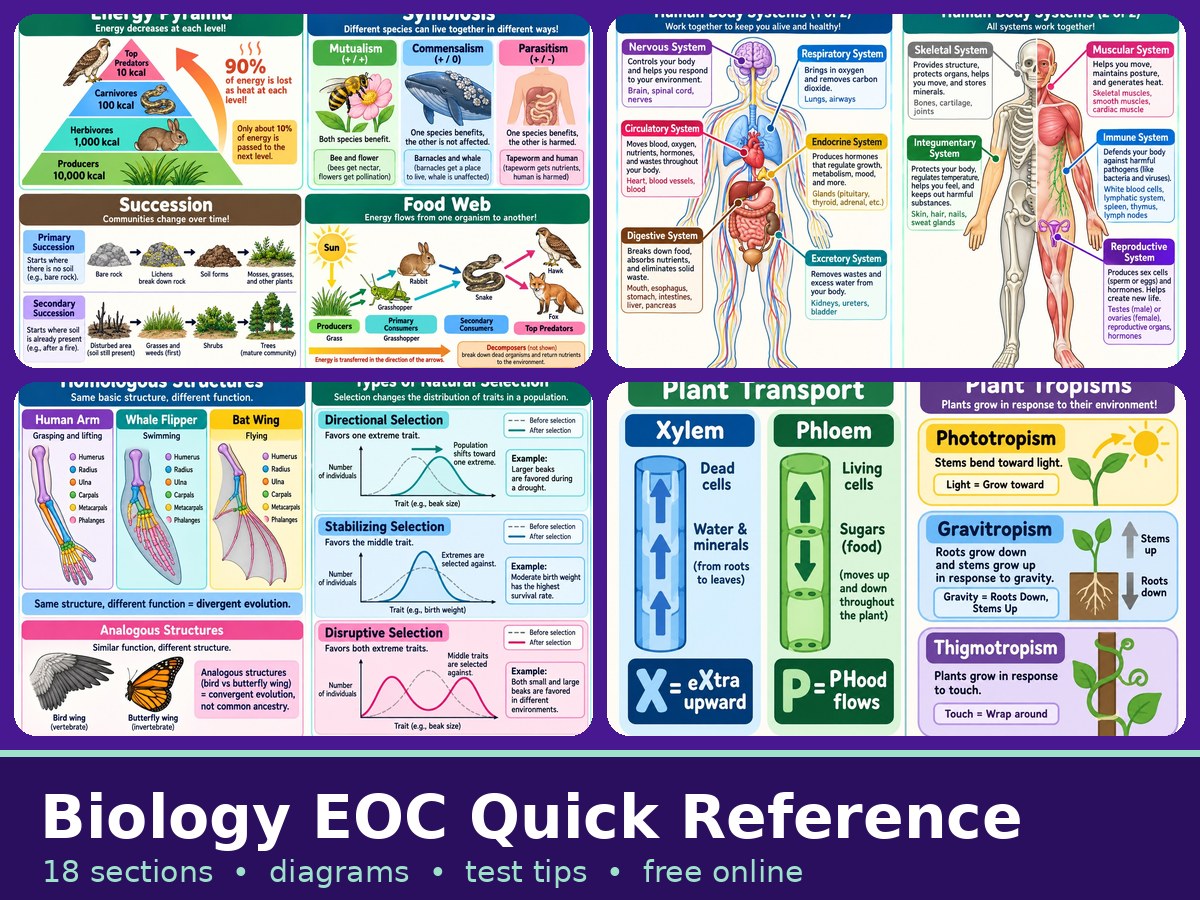
Homologous structures & selection types — adapted from Evidence for Evolution Diagram
"Fitness" = reproductive success, NOT physical strength. Hardy-Weinberg equilibrium = NO evolution. Five conditions: large population, no mutations, no migration, random mating, no natural selection.
🌿 Ecology — organisms & their environment
SC.912.L.17.5, SC.912.L.17.9, SC.912.L.17.20 · Fig. 13.1 — Ecological Energy Pyramid & Trophic Levels (Ecology Diagram)
Fig. 13.1 — Energy pyramid & trophic levels — adapted from Ecology Diagram
10% rule: 10,000 kcal producers → 1,000 primary → 100 secondary → 10 tertiary. Logistic growth (S-curve) levels off at carrying capacity K. J-curve = exponential (unlimited resources).
♻️ Cycles of matter
Biogeochemical cycles · Source: OER Commons / Ecology Education — Biogeochemical Cycles Overview
Carbon & nitrogen cycles — adapted from OER Commons / Ecology Education Biogeochemical Cycles
Phosphorus has NO gaseous phase — cycles only through rocks, soil, and water. Excess fertilizer → eutrophication (algal blooms → O₂ depletion → dead zones). Human impact: burning fossil fuels ↑ CO₂ → greenhouse effect.
🫀 Human body systems
SC.912.L.14.26, SC.912.L.14.36, SC.912.L.14.52 · Source: Anatomy Education Diagram — Human Body Organ Systems Overview
| System | Major organs | Function |
|---|---|---|
| Nervous | Brain, spinal cord, nerves | Detects stimuli; controls body functions |
| Cardiovascular | Heart, blood vessels, blood | Transports O₂, nutrients, hormones, waste |
| Respiratory | Lungs, trachea, diaphragm | Gas exchange — O₂ in, CO₂ out |
| Digestive | Mouth → intestines, liver, pancreas | Breaks down food; absorbs nutrients |
| Excretory/Urinary | Kidneys, bladder | Removes metabolic waste; water balance |
| Endocrine | Pituitary, thyroid, pancreas, gonads | Hormones regulate growth, metabolism, reproduction |
| Immune/Lymphatic | WBCs, lymph nodes, spleen | Defends against pathogens |
| Muscular | Skeletal, smooth, cardiac muscle | Movement, posture, heat production |
| Skeletal | Bones, cartilage, ligaments, tendons | Support, protection, movement, blood cell production |
Homeostasis feedback loops
Innate immunity = immediate, nonspecific (skin, mucus, fever). Adaptive immunity = specific, slow to develop but creates memory cells → lasting protection. Active immunity = long-lasting. Passive = temporary.
🌱 Plant biology
SC.912.L.14.7 · Source: Plant Biology Diagram — Xylem & Phloem Transport in Plants
Xylem & phloem transport — adapted from Plant Biology Diagram
Flower parts — male (stamen): anther (makes pollen) + filament. Female (pistil/carpel): stigma (sticky, catches pollen) + style + ovary (contains ovules → seeds).
🌍 Humans & the environment
SC.912.L.17.20 · Source: Climate & Environmental Science Diagram — The Greenhouse Effect
The greenhouse effect — adapted from Climate & Environmental Science Diagram
| Issue | Cause | Effect |
|---|---|---|
| Deforestation | Agriculture, logging, development | Habitat loss, ↑ CO₂, soil erosion, biodiversity loss |
| Climate change | Excess greenhouse gases from fossil fuels | Rising temperatures, sea level rise, extreme weather |
| Eutrophication | Fertilizer/detergent runoff (excess N/P) | Algal blooms → O₂ depletion → dead zones |
| Invasive species | Non-native species introduced | Outcompete natives; disrupt food webs; reduce biodiversity |
| Overharvesting | Excess hunting, fishing, collecting | Population decline, possible extinction |
Renewable: solar, wind, hydroelectric, geothermal, biomass. Nonrenewable: coal, oil, natural gas, uranium. Greater biodiversity = greater ecosystem stability and resilience.
✏️ EOC test-taking tips & strategies
~60–66 questions · 160 minutes · ~2.5 min per question · No penalty for guessing
Key words to watch for
BESTMOST LIKELYLEASTNOTEXCEPTALWAYSNEVER WHICHALLONLY
LEAST / NOT / EXCEPT → you are looking for the WRONG answer. ALWAYS / NEVER → often incorrect, use caution.
| Data type | Strategy |
|---|---|
| Graphs | Read title, axis labels, and legend first. Identify trends (increasing, decreasing, constant). Look for where lines intersect or level off. |
| Data tables | Read column and row headers. Compare values. Look for patterns, outliers, highest/lowest values. |
| Diagrams | Read all labels and arrows. Understand what process is being shown. Trace the flow from start to finish. |
| Experimental results | Identify the independent and dependent variables. Find the control group. Ask: "What was the effect of the change?" |
Read carefully
Read the full question before looking at the answer choices — the stem often contains essential clues.
Eliminate wrong answers
Cross out clearly wrong options first. If two remain, re-read the question for the more complete answer.
Skip & flag
If stuck, skip the question and return later. Never spend more than 2–3 minutes on a single question.
Always guess
No penalty for guessing on the Biology EOC. Never leave a question blank.
You've got this! You have worked hard all year. Trust your preparation, read carefully, and take your time. You are ready for this exam.